
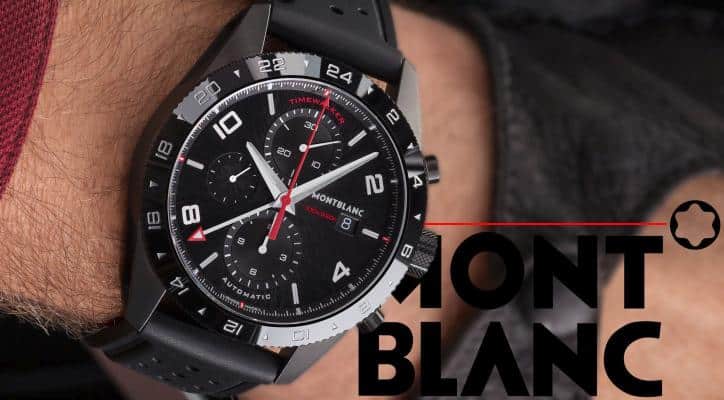
The Montblanc TimeWalker Automatic Chronograph UTC Ceramic 116101 is a nice (if a bit overpriced) addition to their line of sporty chronographs. While the choice of the movement and the combination of materials look more “acceptable” rather than “exciting,” we at WorldWatchReview.com would still recommend getting one of these watches if the price is not a problem.
Montblanc TimeWalker Chronograph UTC: Overall Impression
It’s been more than three years since I last reviewed a Montblanc wristwatch. Not that there weren’t any new products. It was just I somehow found all of them depressingly boring in their carefully calculated refinement.
Frankly, even this TimeWalker Chronograph UTC Ceramic doesn’t make me want to reach for my credit card.
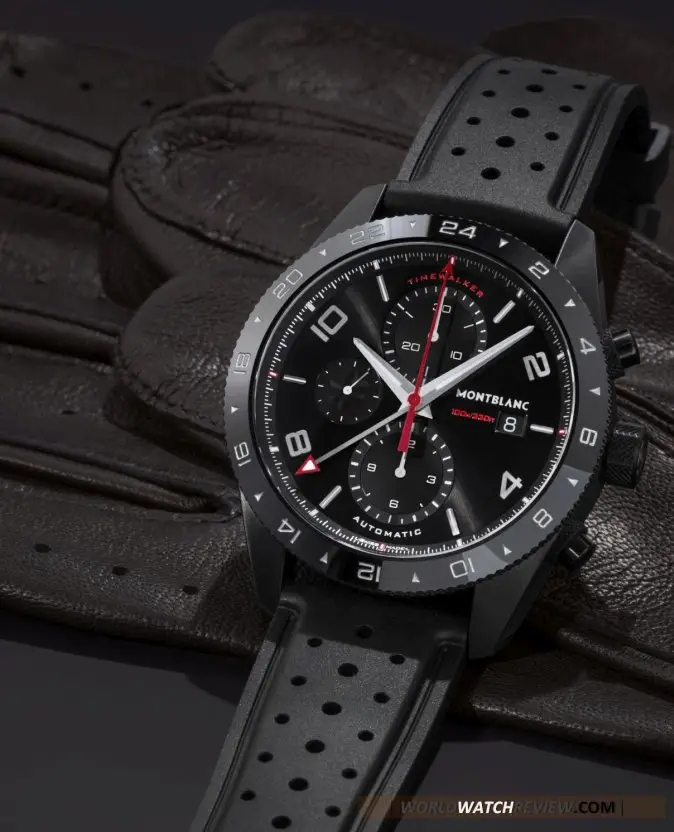
Still, I should probably admit that it looks like a nice addition to their collection of “sportified” luxury timepieces.
Also, it will probably be popular among those interested in something different than the ubiquitous Omega Speedmaster.
Of course, there is nothing groundbreaking or innovative about this watch. Yet, it successfully mixes the elegance of a gentleman’s gadget with a chemically pure mojo of an expensive sports accessory.
I hope the phrase has some meaning to you, I surely tried to create a good metaphor here.
It’s not a coincidence that Montblanc decided to use an interior of a vintage luxury sports car for the promotional photos.
Yes, it is a bit overpriced for the way it limits the use of a scratch-resistant composite material to only its rotating bezel. Yes, I would prefer it to feature a movement of a higher pedigree. But the Montblanc TimeWalker Chronograph UTC objectively looks great and, if cash is not an issue, is not that expensive after all.
The Case
Being just a medium-priced luxury watch, this TimeWalker Chronograph UTC minimizes the use of scratch-resistant ceramic material only to its rotating bezel. So, the name is a bit deceptive.
The rest is the usual stainless steel, which is treated with a black DLC coating. The treatment, too, usually does a good job at protecting your watch from unexpected dings and scratches.
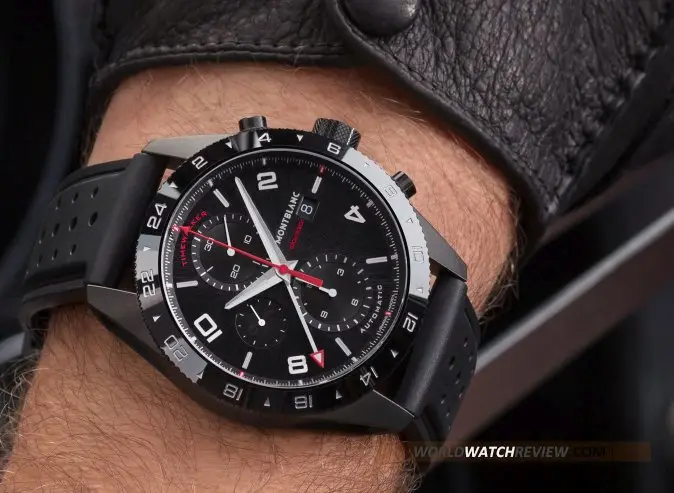
The coating comes in an unusual ‘matte’ finish. It not only blends nicely with the perforated rubber strap but also makes the glossy ceramic bezel really stand out.
When it comes to the choice of materials, I don’t think it is them being greedy. It’s rather that it’s still difficult to manufacture a fully-ceramic timekeeper with a good movement inside when you are trying to squeeze it into a sub-€5000 niche.
Yes, there is the 2016 Tudor Fastrider Black Shield Ducati 42000CN sporting a sticker price of approximately $5000. But the relatively low price probably has something to do with Rolex still limiting its profit margins to sell more timekeepers under its resurrected sub-brand.
The choice of caliber resulted in the timekeeper’s case growing in size.
Measuring more than 15 millimeters top-to-bottom, it is thicker than some “divers” rated for more than 300 meters (this one, by the way, features a water resistance rating of just 100 meters.)
Yes, the thickness is still manageable but it may limit your choice of clothing.
On the other hand, if you are into deliberately massive timekeepers, there is a good chance that your wardrobe has already been adapted to larger watches, who knows?
The Ergonomics
The basic ergonomics is, um, industry average.
The push-pieces are just long enough to offer a comfortable way of operating the chronograph. They are still short enough not to give you too many false starts (as my experience tells me, they are virtually inevitable, but I also tend to wear my watch low on my wrist, your experience may be different,) which is good.
The winding/setting crown is also standard for their current TimeWalker collection. Even though yours truly would prefer it to be slightly thicker, the notching on the crown still gives you a good grip when you need to readjust the time.
Frankly, I don’t see where to find a fault in this well-calculated product when it comes to the case and the way that it looks. The watch was designed by true professionals and it shows.
The Dial
I was a bit disappointed when I first found out that Montblanc decided not to use the bold styling of their earlier Urban Speed and Voyager UTC collections in their new, 2017 range.
Although I perfectly understand that, on a market that contracts for four years in a row, the strategy of turning back to the proverbial “roots” often seems to be the best, it would still be nice if the Montblancs looked more unique. Well, at least they are not generic.
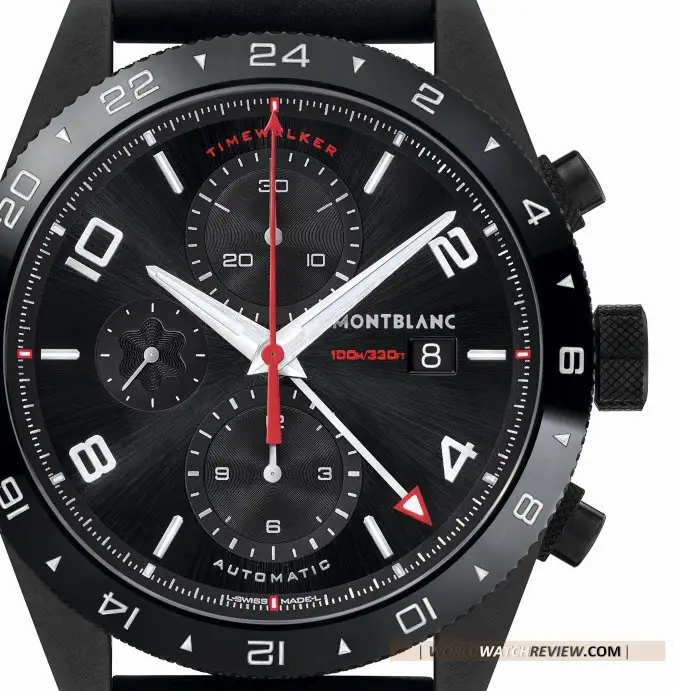
For this new batch of TimeWalkers, Montblanc returned to the styling that they have used back in 2010.
The only additions are the even less interesting dauphine-style hands and slightly smaller Arabic numerals interspersed with stick-shaped hour markers.
Both the Urban Speed and the Voyager are still available via the brand’s website and numerous online stores. However, if the words “classic” and “heritage” mean more to you than “avant-garde” and “bold,” please do continue reading this review.
The Legibility
As usual for their blacked-out lines, both the numerals and the indices are rhodium-plated for better contrast on the black background of the sunburst-style dial with the nighttime legibility slightly enhanced with tiny luminous rectangles placed on the chapter ring, as well as with narrow slots on the hour (primary, the secondary one has the traditional -again, some may call it ‘generic’ triangular-shaped red tip-) and minute hands.
While speaking of legibility, I must admit that the dial doesn’t look too cluttered here: with the number of inscriptions and markers reduced to a minimum, it is always easy to grasp current time and/or chronograph readings with a glance.
What you may not like, however, is the way the secondary time zone display.
As traditional as it is, it is still not the best way to tell time: first of all, you have to mentally jump between 12-hour and 24-hour displays and this may become a source of irritation at some point, and, second, there is a noticeable visual jump between the chapter ring on the dial and the second time zone numerals on the unidirectional rotating ceramic bezel.
In this respect, the dial on the aforementioned Voyager UTC was a great deal more readable and user-friendly than this “traditional” one.
As for the other indicators, they are, too, traditional and come courtesy of the mass-produced mechanism that Montblanc decided to use for this iteration of the TimeWalker family (um, again: see below.)
While the visual accent on the vertically placed chronograph sub-dials (a 30-minute counter at 12 o’clock and a 12-hour totalizer at six) looks nice, the readability of the small-seconds indicator, which is ‘blended’ into the timekeeper’s face for a cleaner look suffers to a degree with only 5-seconds markers placed on its rim.
On the other hand, the lack of readability here gives you a good excuse to use the chronograph more often: the central-seconds hand here allows you to measure time intervals with accuracy up to 1/4th of a second, which is good enough for most applications.
The Mechanism
As the Swatch Group pulls out of the wholesale ebauche market, legendary ETA movements are starting to get pretty hard to come by. It is no wonder that for their less expensive models Montblanc gradually replaces them with mechanisms done by Sellita. Yes, Montblanc has its own Manufacture-grade calibers, but those, regretfully, power far more expensive models that allow the Swiss brand to keep good profit margins.
This particular Caliber MB 25.03 is based on the well-known Sellita SW500 blank movement (the same that powers the enormous Oris ProDiver Dive Control Chronograph.)
Competing with the legendary ETA 7750, this is a natural-born chronograph, not just a simple three-hander with an add-on module.
I mean, it still has a Dubois-Depraz DD225 second time-zone module, but it’s kind of normal in this niche.
Of course, the add-on module will decrease the mechanism’s overall outstanding reliability simply because there are more moving parts, but not in a big way. After all, a person buying a complicated watch should always bear in mind that, like any sophisticated mechanism, it will be more expensive to keep in good working order than a simple three-hander.
Anyways, the mechanism has been here for more than six years and enjoys a good reputation not only among many brands but with end-users as well. The only problem that you may probably encounter here is that the SW500 hasn’t acquired the status of a “legendary” movement and this may somehow damage the timekeeper’s resale value.
I can’t say whether the batch of mechanisms selected to power this member of the TimeWalker family was fine-tuned in any way (all I can say is that they often do at this price point,) but it’s a pleasure to note that the mechanism was at least nicely decorated. It rocks a personalized oscillating weight with Geneva stripes and branding, as well as a set of polished and blued screws and sand-blasted and beveled bridges.
By today’s standards, the 46-hours power reserve that the mechanism is good for after being fully wounded is pretty underwhelming.
Yes, it is practical enough if you plan to use the Montblanc TimeWalker Chronograph UTC daily, however, if you are not going to wear the timepiece on a weekend you will either need to place it into an automatic winder or face a painful process of rewinding and resetting the chronograph on a Monday morning.
Pricing & Availability
In Europe, the TimeWalker Automatic Chronograph UTC 116101 will be available at a recommended street price of €4990. The price sticker is impressive, but, surprisingly, the watch is a bit less expensive than their earlier ETA-based chronographs.
As far as value is concerned, I would still say that it is overpriced. It would be wiser to not rush and buy one as soon as it appears on a shelve of a multi-brand store near you, but to wait until the next Black Friday sale.
See also: Montblanc Star World-Time GMT
Photos: Montblanc
WWR’s verdict
Originality 4.5/5
Build quality: 5/5
Usability: 4.5/5
Overall Legibility: 4/5
Nighttime Legibility: 4/5
Value for money: 4/5
Overall Rating: 4/5
Montblanc TimeWalker Chronograph UTC 116101 specification
Price: €4990 (MSRP, price is actual at the moment of publishing this review)
Winding: Automatic
Movement: Caliber MB 25.03, base Sellita SW500 with Dubois-Depraz DD225 second time-zone module, Swiss Made
Number of jewels: 42
Cadence of Balance: 28,800 vph
Power reserve: 46 months
Movement decoration: Geneva stripes on the rotor, blued screws, sand-blasted and polished bridges
Functions: Hours, minutes, seconds, date, chronograph, UTC (second time-zone)
Case: Black DLC-treated stainless steel
Bezel: Black ceramic
Shape: Round
Size: 43.00 mm
Case height: 15.20 mm
Front crystal: Sapphire, domed, anti-reflective
Back: Sapphire, smoked
Dial: Black
Numerals & Hour markers: Applied, luminous, rhodium-plated
Hands: Luminous, polished, rhodium-plated
Water resistance: 100 meters
Strap: Perforated black rubber strap with stainless steel and black DLC triple folding clasp