
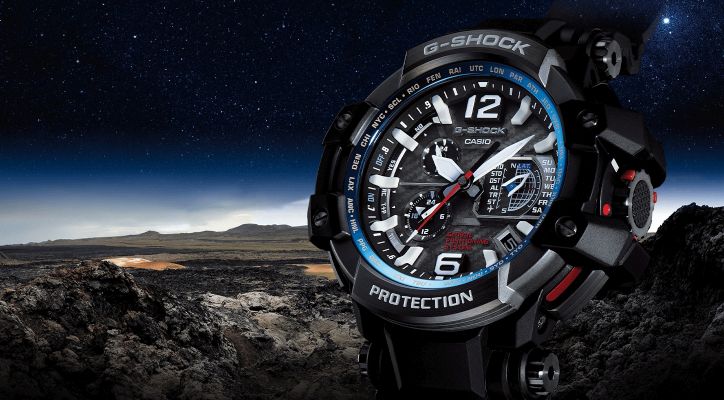
Inside its oversized body, the 2014 Casio G-Shock GravityMaster GPW 1000 delivers a tiny GPS receiver and a state-of-the-art solar-powered quartz movement. The proverbial cherry on top is their signature Multi-Band 6 technology that allows the device to automatically receive standard time-calibration signal from atomic clocks.
What else would you probably ask from this little monster? Making you breakfast?
Overall Impression
Most of us tend to associate the G-Shock with inexpensive, plastic-and-rubber timekeepers. Yeah, the ones you usually find at Walmart’s “Jewelry” section priced at about $50-$150 apiece. However, there is a whole plethora of premium-priced “daily beaters” that retail well North of $1000.
Featuring finely finished metal bodies and an extensive list of features, they give their Swiss-made competitors a nice run for their money.
For a fine example, you can check this sporty G-Shock Metal-Twisted. At the moment of me writing that article, that model had an MSRP of about $1500. Now, would you get that Japanese beauty or a quartz-powered Breitling at three times the price?
The Affordable Price
This new Casio G-Shock GravityMaster GPW 1000 belongs to the same niche of “upscale” tool watches. Thankfully, it’s not as expensive.
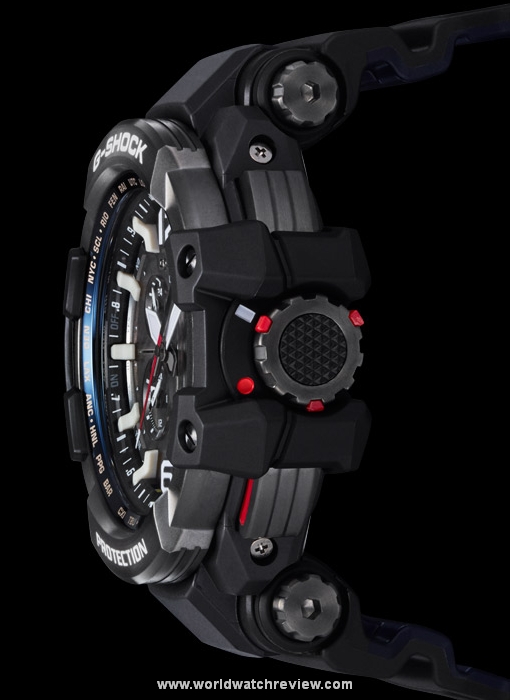
Retailing for $950, the gadget won’t stun anyone with elegant curves or flowing lines. On the contrary, the case is deliberately rugged. In fact, it looks like some military-grade piece of equipment designed to withstand a nuclear explosion to serve some yet unborn hero in a post-apocalyptic world in his or her quest for some Essential Artifact.
The Advanced GPS Module
Its selling point is the advanced quartz mechanism with an extensive set of useful features.
The most useful among them is the ultra-compact GPS LSI chip that the Japanese juggernaut Sony revealed last year.
Originally designed for smartphones, tablets, and mobile computers, the device is smaller than a nail on your pinky finger.
It was still relatively large, even for an adventure watch, but was perfect for the traditionally oversized G-Shock family.
With its deliberately oversized body that measures 66 by 56 millimeters long and wide, and is almost 19 millimeters thick (there are not so many automatic chronographs that can rival its dimensions) the GPW 1000 has plenty of space for this chip.
The Atomic Timekeeping
Working in pair with Casio’s trademark Multi-Band 6 technology, the tiny unit greatly increases the timekeeper’s precision.
The atomic timekeeping will come particularly handy when you pay a visit to some obscure country in the middle of nowhere. The definition of which is being too far away from radio towers in the United States, England, Germany, Japan and China that broadcast extremely precise time signal measured by atomic clocks.
Although the stations are powerful, there is always a good chance that your watch will not be sensitive enough to receive its signal somewhere in Russia or an African country. That’s where the GPS LSI chip comes to the rescue. Always knowing where it is, the timekeeper will be able to calculate local time even if the radio signal from the atomic clocks is not available. Must be quite convenient, that.
The 66mm Case
Trying to justify the gadget’s high price (I mean, there are lots of easier and cheaper ways to get information about local time. We all have our smartphones after all), the Japanese watchmaker employed the best materials currently available for such a timekeeper.
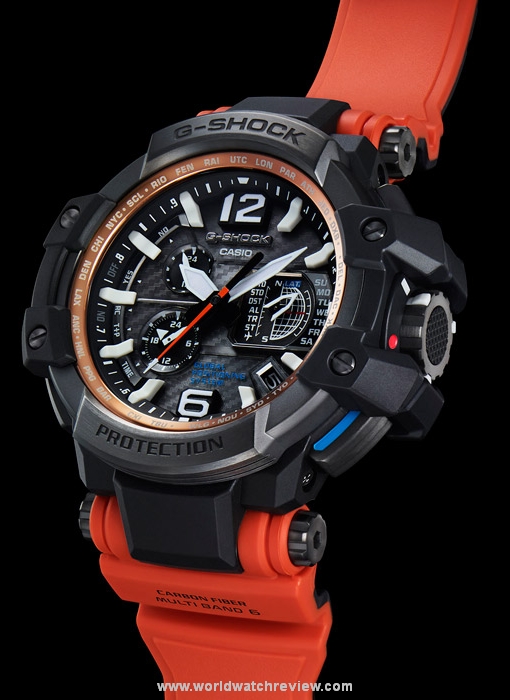
The GPW 1000 has its case protected with nice soft-to-touch resin. There are also carbon fiber inserts here and there to make it look sportier. And there is even a DLC-coated forged metal bezel that is more resistant to dings and scratches.
The Dial
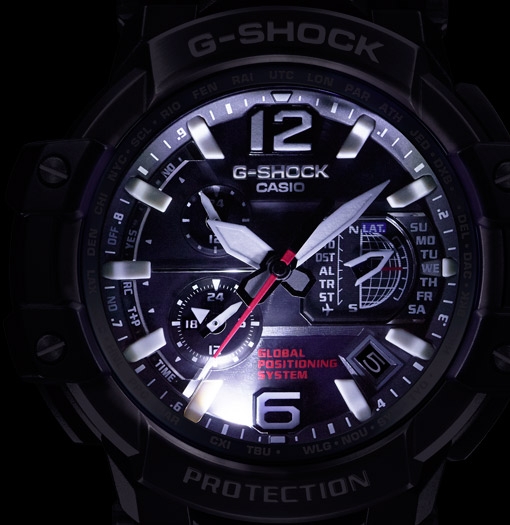
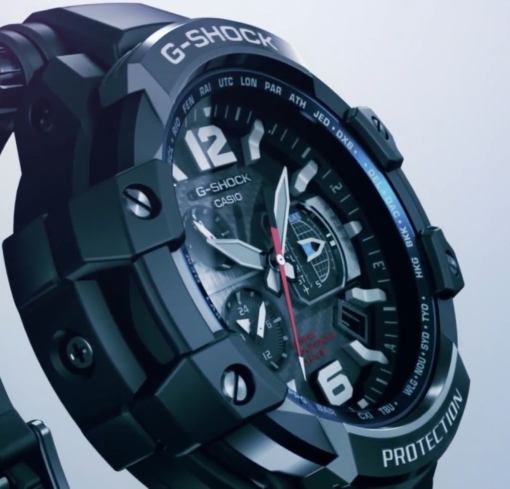
The dial is definitely busy. Besides the usual three hands and a 12-hour chapter ring, there three more sub-dials and a tiny date window.
Yet, it somehow doesn’t look cluttered: you can easily read time and date thanks to the oversized hands and LOTS of lume.
As a side note, you can see in these promotional photos that the hour and minute hands are a bit too wide. At some positions, they can obstruct the view at the second time zone display, as well as at the alarm sub-dial and the date aperture.
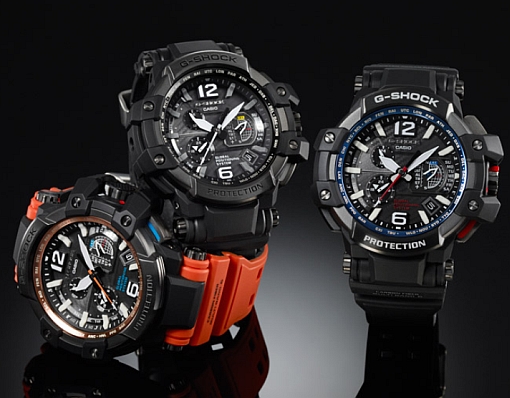
All in all, the GravityMaster makes a good impression. Despite its signature styling which is usually associated with entry-level models for kids, it doesn’t look cheap.
If money is not a problem and the styling feels okay, you could probably be more than satisfied with this gadget.
See also: Daily Clutter: Seiko Prospex Solar Pilot Chronograph
Photos: Casio
WWR’s verdict
Originality 3/5
Build quality: 5/5
Usability: 4/5
Legibility: 4/5
Value for money: 4/5Overall Rating: 4/5
Casio G-Shock GravityMaster GPW 1000 specification
Price: $950 (MSRP)
Movement: Quartz, “shadow dispersing” solar cell-powered
Functions: Hours, minutes, seconds, calendar, second time-zone, alarm
Case and Crown: Stainless steel with a fine resin frame
Bezel: Forged metal with DLC coating
Shape: Round
Dimensions: 66.00 mm x 56.00 mm
Case height: 18.80 mm
Dial: Black carbon fiber
Numerals: Arabic
Hour markers: Luminous
Hands: Luminous
Water resistance: 200 meters
Strap: Rubber band with carbon fiber inserts
Crystal: Sapphire
Back: Solid